The Economy Is the Medium
Kim Asendorf wrote a market as a composition. It took the live-minting boom, the bust, and a patron's house rebuilt from the old market's parts — and I was there for all of it.
a conversation with Kim Asendorf
on the record: Casey Reas · DEAFBEEF · Anika Meier · Leander Herzog · Andreas Gysin · jiwa · Eli Scheinman
First serialized in Tetragrammaton — Part One ↗ · Part Two ↗
0 of 128,000,000 pixels deposited — read live from the PXL contract · full record
1 · The room
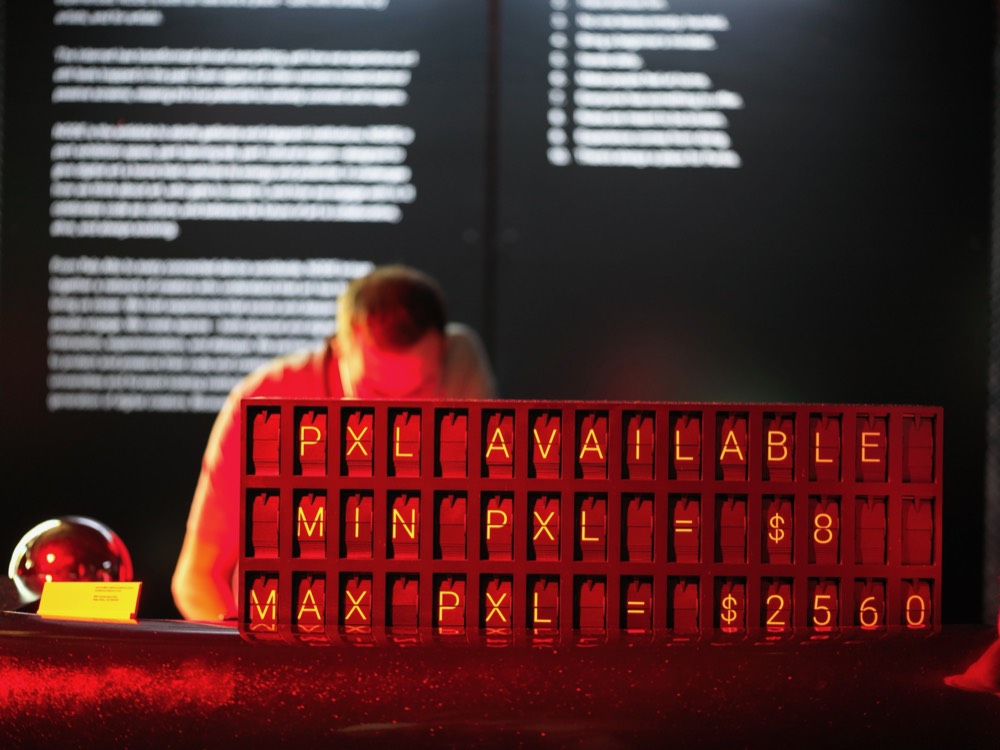
The one door into this economy is a front desk on University Avenue, and what it hands you is not a ticket. The show is free to walk through. "This exhibit is free to view," the docent says, in a script I heard rehearsed at the noon walkthrough, "but if you wish to participate, you can go to the front desk and purchase a pixel that will then be minted into the exhibition." The pricing is simpler than the split-flap board makes it look: every pixel costs the same fifth of a cent, at every rung of the ladder. Eight dollars buys the smallest card, 4,000 pixels; $2,560 buys the biggest, 1.28 million. Every step between buys more pixels at the same rate. House rules allow up to five cards a person. No bulk discount, no grades: the ladder doesn't rank buyers, it measures appetite.
Past the desk, daylight ends. Qian Qian built the entrance so you would "lose the sense of perspective in the larger than life PXL world." It is a new space constructed inside the room, dark as a camera body. Its wayfinding uses the graphic language of Kim's own website and the NET traits he drew. Even the signage is authored by the system it explains.
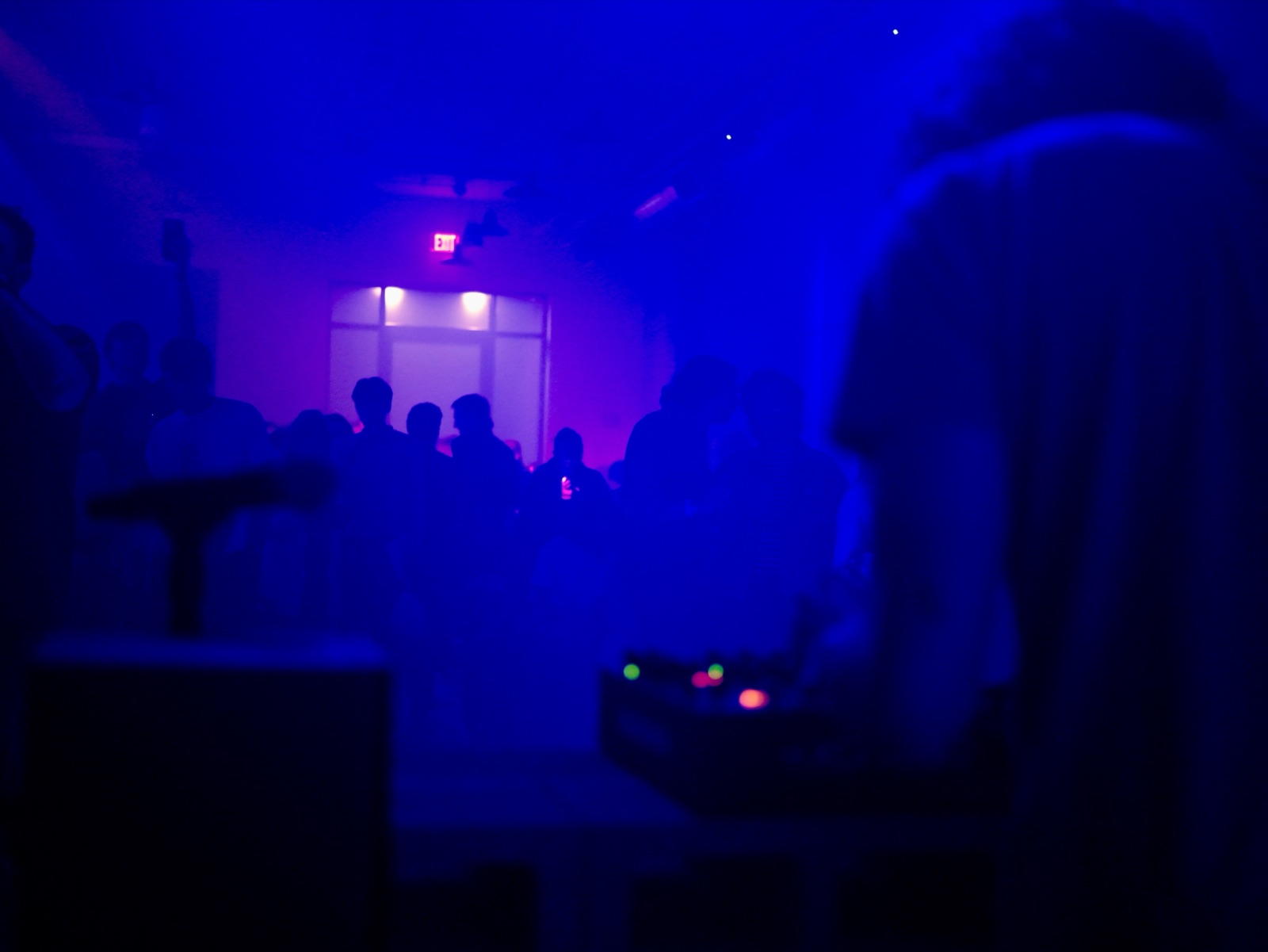
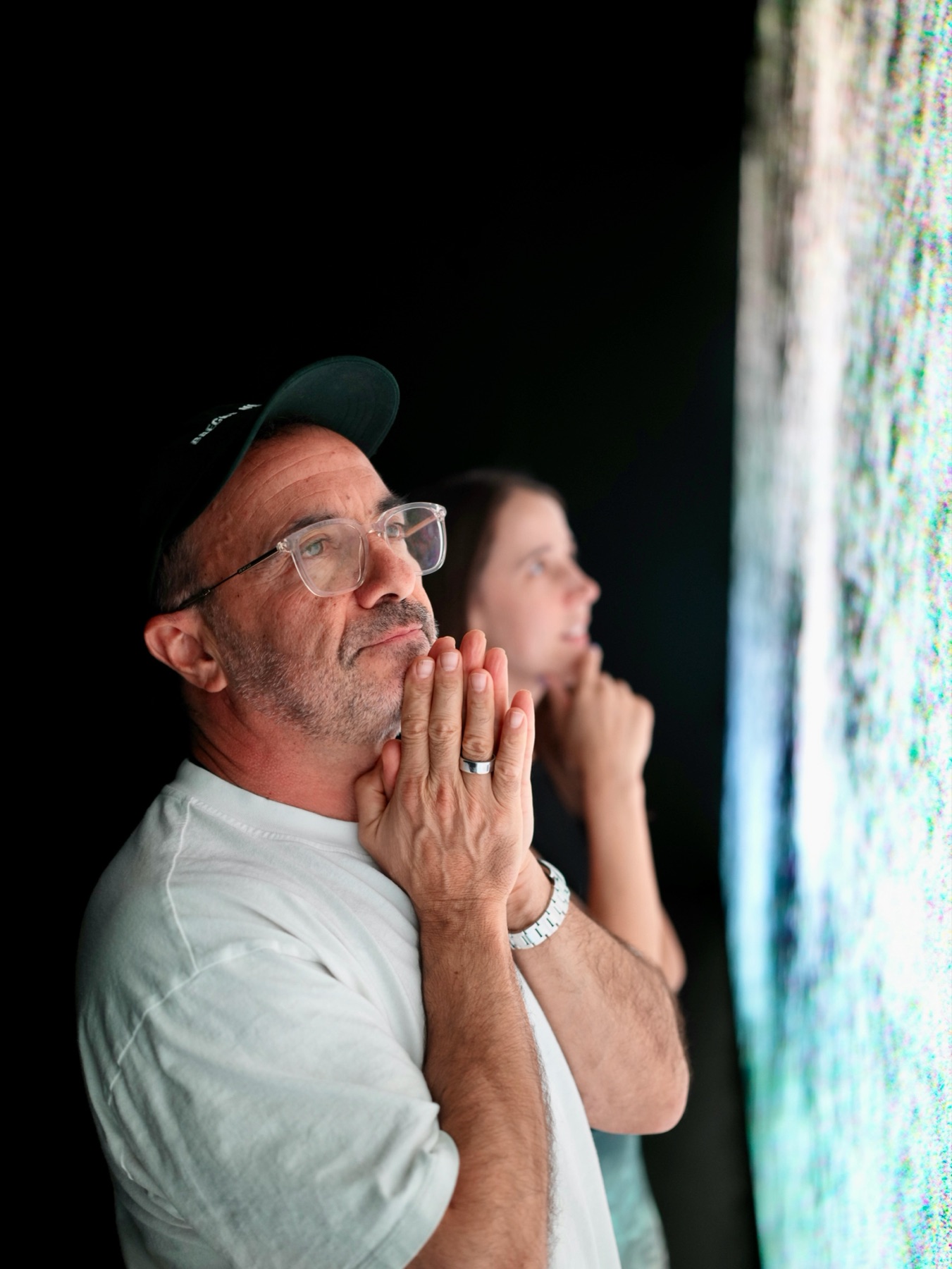
The screen at the center began the evening the way nobody had ever seen it: empty. "I've never seen that screen in an empty state," someone on the team said at the walkthrough; until that afternoon there had been nothing real to show. The contract cleared mainnet at 3:56 p.m. Pacific. The doors opened at 5:30. The composition's entire life fit inside that gap. When the room filled, the screen was still black: a billion-pixel economy, open for business, holding nothing. The first injection was waiting for the audience.
Tapping your card initiates a transaction, and the docent's script is precise about the part that matters: the exact moment you tap affects what you will see. A spotlight finds you where you stand. Your pixels join a queue. Every fifteen minutes the accumulated mints inject into the composition in a single batch, arriving the way Kim designed them to arrive: not sliding in flat from a corner but descending "like a ring coming down… a natural phenomenon." For the first injection of the night they suspended the cycle entirely, so the opening beat could be conducted rather than scheduled. When it came, most of the room just stood and looked around. Live minting is built to be felt: communal, physical, in the room. But wiring what your senses report to what a chain just did is not yet anyone's reflex. The first beat landed the way new rituals do: awkward, and energizing for the same reason.

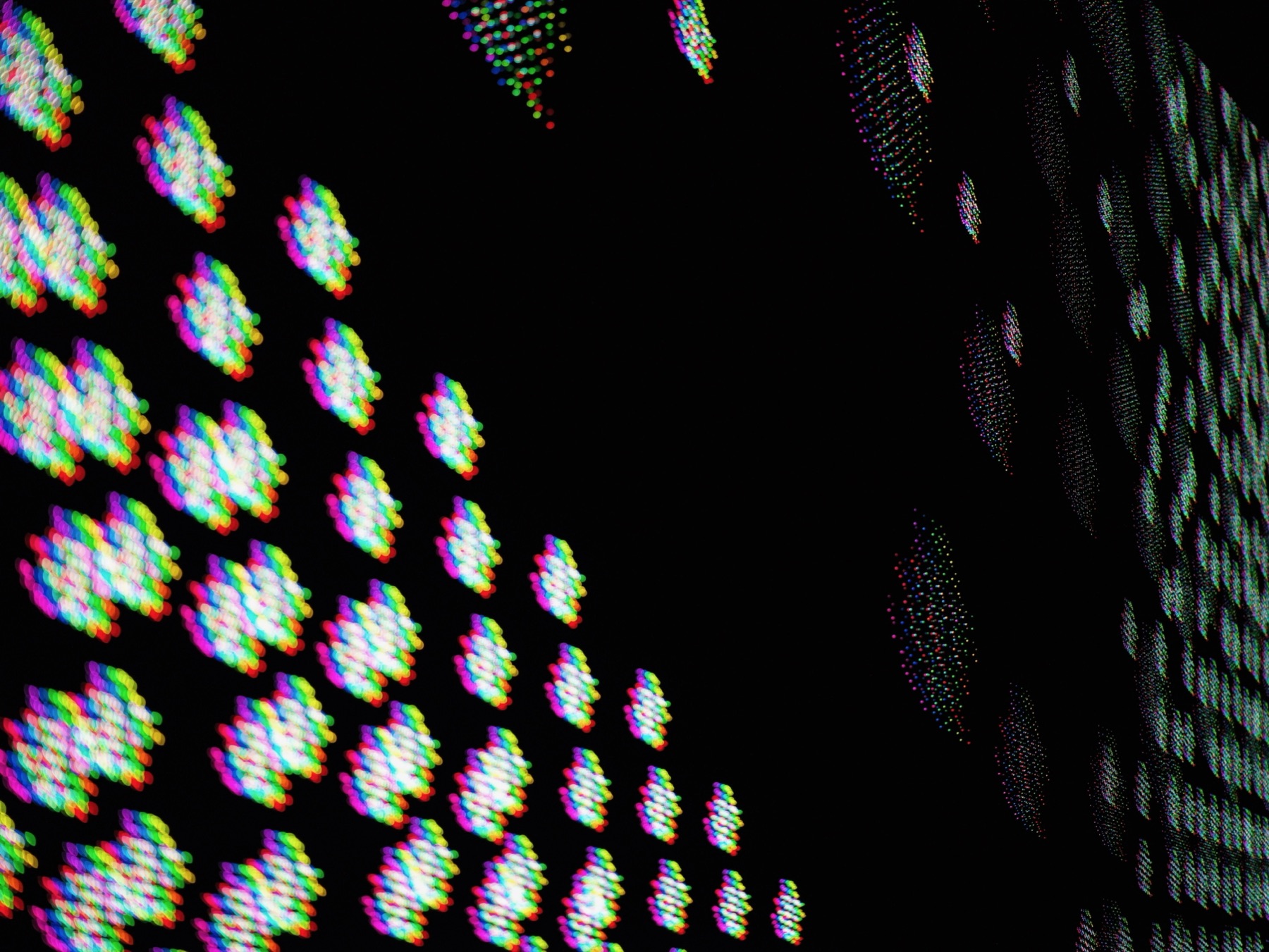
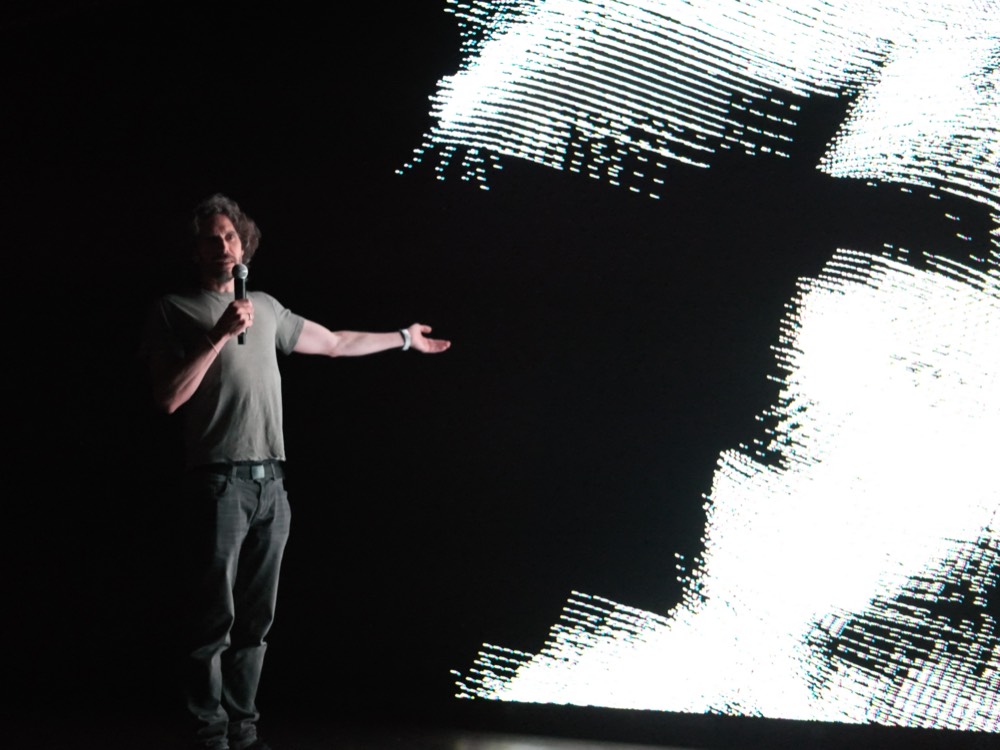
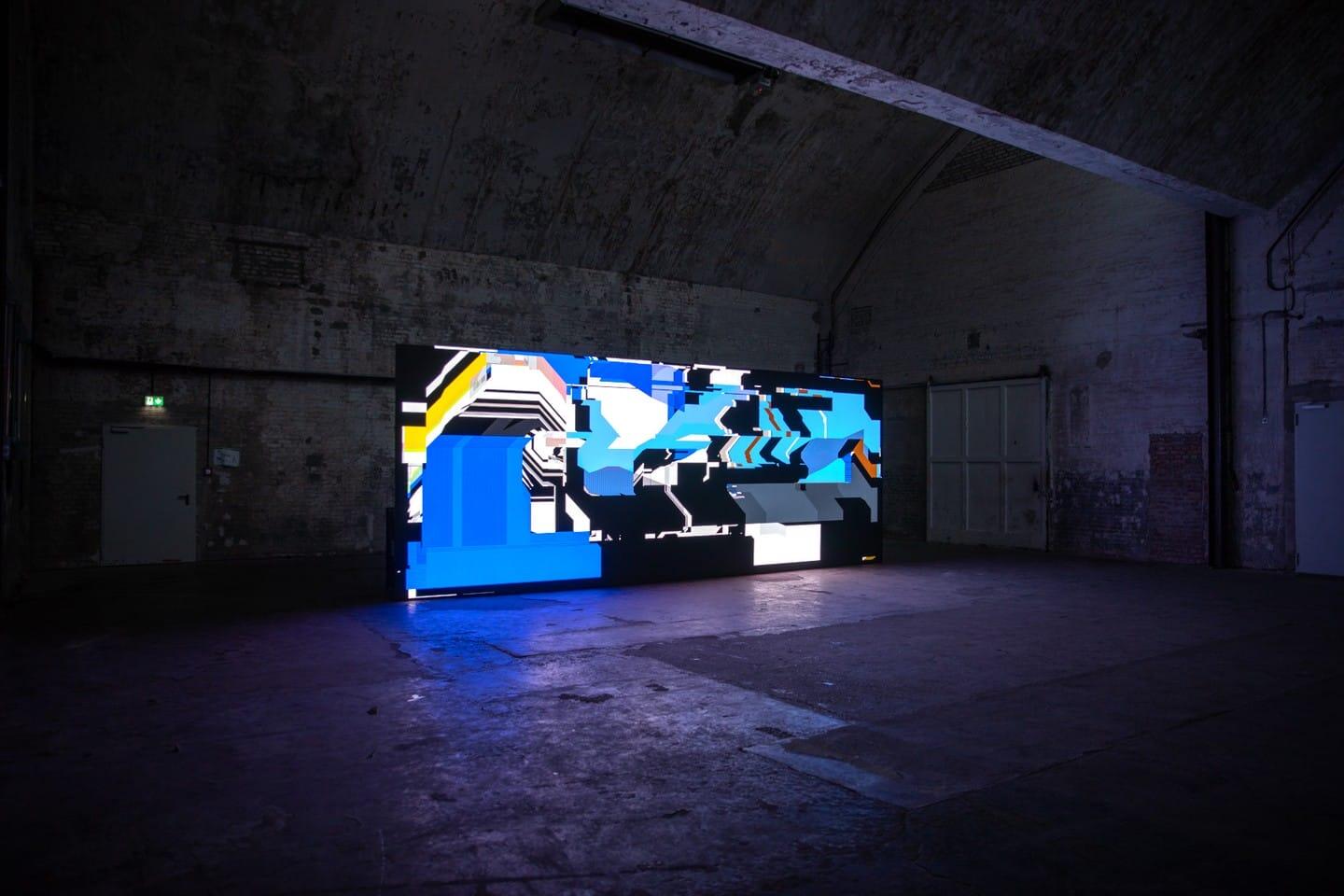
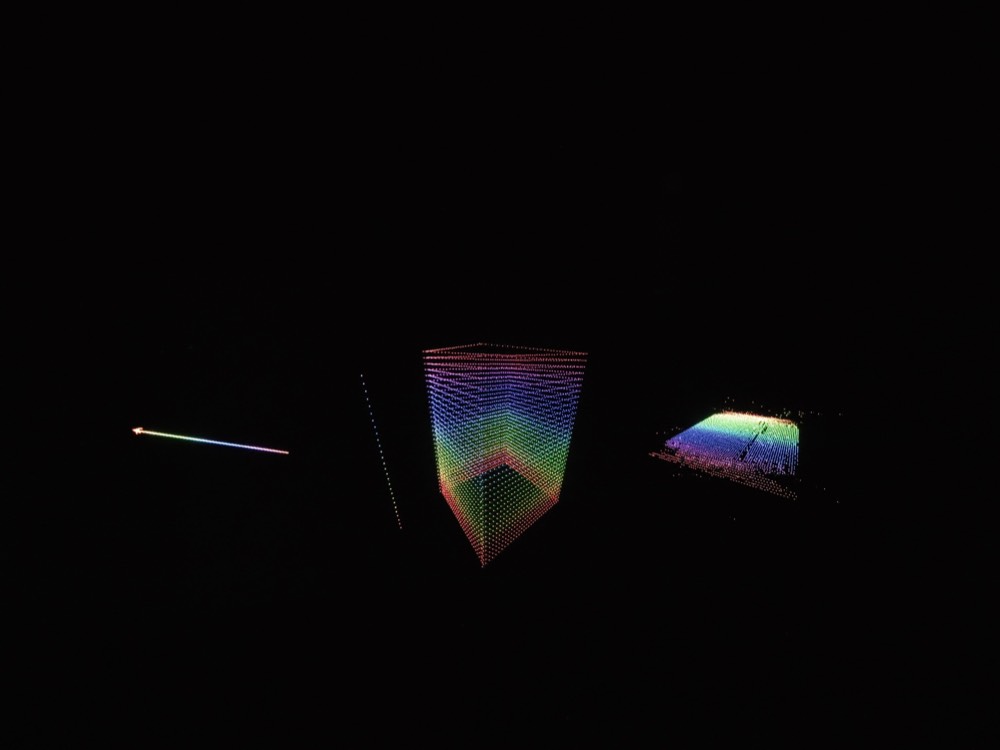
The wall is twelve thousand pixels wide. At the VVIP hour Kim stood in front of it and gave the room its owner's manual: the groups his pixels cluster into, the tweens that morph them, the five camera modes ("inspired by real camera movements"). Mid-sentence, a stray artifact bloomed across the composition. He handled it the way you can only handle a thing you have total title to: "This is new data that comes not exactly from my code — the system is so complex. It's not my fault. When it's doing this, just ignore it for a moment." The room laughed. The work went on computing. "This work is new," he said. "We just started here from zero, and I hope it grows further."
At nine the artist becomes the DJ: one hour of techno in the garage, the party the room's designer told me, in writing, "isn't part of the PXL ecosystem." The economy stops at the garage door; the practice does not: "the music I played," Kim said at the artist talk the next day, "was one hundred percent generated. It was my own code creating the music… no samples… I designed every instrument." Even the party fenced outside the work was made of the work's material. Selling still has a closing bell: the pixels stop at ten. The building, someone said, stays open "until we mint the last pixel tonight." By midnight, seventy-five million pixels had entered the vessel: 75,030,254 of a 128-million capacity.
The economy is not how the work is sold. It is what the work is made of.
2 · What PXL actually is
Kim Asendorf did not put an artwork on a token. He made the token the pigment. Ask him what a pixel is and he'll give you a koan first: "a point of light, but not a classic point of light, which is usually a circle. The pixel is a rectangle. It's almost absurd in itself: how can a light be rectangular?" Then a childhood second: the Nintendo Entertainment System, screens where every pixel was two millimeters of visible rectangle. "An aesthetical choice, not an ideological choice — it's very personal. I just love it." His whole display philosophy fits in one sentence: "one pixel is exactly one LED… if the pixel really is at the right spot, it's so beautiful in itself. That's the pixel I'm looking for." And the ownership claim underneath the tokenization is an authorship claim: "My pixels are special because they do what I want — I trained many, many years… that's when they become my pixels. I don't use a JPEG and see them as my pixels just because they're on my screen. I created them. And now I tokenize them." The token, in other words, is "a statement that the pixel itself is worth to be tokenized." He has spent his career on the thing everyone else treats as invisible infrastructure, and the contract is how he signs it.

PXL is a fixed supply of 1,024,000,000 pixels, written into a smart contract before any image existed. That number is the first compositional decision. Kim once told his studio the cap was "the first contract I made with myself." Then, on camera in the pre-opening interview, he corrected his own epigraph. It was the first of several corrections that would alter this account: "It's not exactly the first contract — I've written blockchain contracts for other works — but it's a contract that is bigger than just a single work. A super contract." One that "sets a limit of how far I can work with that topic." The limit measures a budget for a body of work rather than a countdown to an ending: "how many works under this umbrella can I do?" And a contract with yourself, as we will see, can still leave choices to its author.
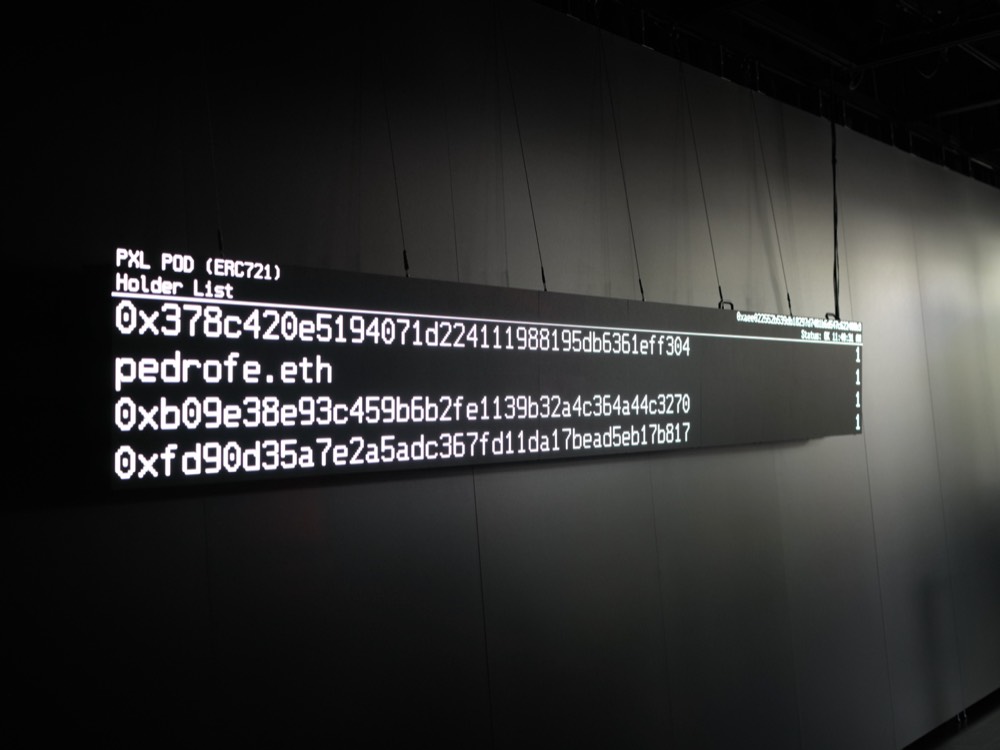
Three surfaces draw down the one supply. Kim said it plainest to the opening-night room: "all these works you are seeing here tonight are using the same pixels… they are interchangeable. You can take the pixel out of one work and put it into another, if you own it." PXL DEX: 256 works, each an embedded reservoir you can fill and drain; the image's density moves with its balance, and a drained deck goes black. PXL POD: 256 more that only watch, built, in Kim's words, "to prove the point that the PXL token… can now be used in the second work." PXL NET is the one-of-one that opened at NODE on July 11. Kim described it to me in March, mid-build, in one sentence that contains the whole design brief: a new system whose goal is "as many pixel as possible," where "that comes with limitations, that hopefully lead to new ideas and visuals." Capacity first, then the constraint, then the form.
Token 0 is the network itself: in Kim's description, it sees every pixel in the system and owns none of them. You join by depositing pixels; you get a receipt, a collection called PXL NODE, though your pixels may not form a discrete node of their own. Kim, walking me through it on opening day: even a large purchase "will appear as single pixels and join existing nodes — so you cannot say that you really created a node, but you still build out the network with your new contribution." You buy in; the network decides what you become. Kim's own public one-liner for all of this, from the artist talk: "Pixels should never be locked somewhere. Whatever you do here, even if you buy these pixels, you become just a lender to the network. You can get your pixels back out if you want." You can leave, but only completely. There is no exit fee. Kim corrected me in writing after I assumed otherwise. On opening day I asked whether a fee could ever be added later, and he closed the door entirely: "It cannot be added… I made it free." Forever. The architecture backs the witness reading. Token 0 and the pixel ledger are separate code bases: the one-of-one renders the network but lives entirely outside it, holding no position in the thing it sees.
And one more design fact, stated to me plainly: who will hold Token 0 is not disclosed, on purpose. The work's center is a witness whose owner declines to be witnessed.
The witness token cost five dollars to deploy. Kim told me so the day before the POD mint: "just paid $5 to deploy the contract and ~60kb data" — twenty-two and a half kilobytes of it the DEX code itself — and I keep coming back to that number: a billion-pixel market, a designed death, a peg, a witness token, sixty kilobytes, five dollars. The materials bill of the medium. The medium stayed wet until the last minute. At noon, walking the finished room, I heard Kim say the NET contract was still one test away from mainnet: "mainnet deployment is crazy shit." At 3:56 that afternoon it landed, block 25512504, contract name "Net," total cost about a dollar. It did not go quietly. Two contracts had to land in sequence (an onchain SVG renderer first, then Net, which needs the renderer's address), and mid-deploy his script threw an error. "That means super crash," he told Amanda afterward, still coming down from it. The chain was fine; only his waiting code had blinked. "Nerve-wracking every time." Ninety-three minutes before the doors, the artist emailed me the address, one line, no commentary. The billion-pixel economy's final surface cost less to deploy than the sandwich he'd eaten while testing it.

The sale is as designed as the contract: venue only, RFID cards, a NODE iOS wallet, the same flat peg from the front desk. The contract itself enforces each deposit between 4,000 and 1.28 million pixels. NODE's tagline for all this is NETWORK MAKES ART WORK, which the show means literally.
To see how an artist came to write an economy, I have to go back four years, to a market that worked differently. I was there, and so was everyone else in this story. Read me as inside: that is both the disclosure and the method.
3 · London, July 2022
In the summer of 2022 the most alive room in digital art was a minting floor. Bright Moments, the gallery I founded, had built its whole model on a single inversion: the moment a generative artwork comes into existence (the transaction itself) could be an event you attend. Minting live onchain wasn't new. Art Blocks had made the long-distance reveal a genre. Bright Moments' invention was staging the mint in person: a room watching the transaction become the work. The CryptoVenetians in Venice Beach in 2021, a thousand tokens generated one at a time in front of the people who claimed them, were the proof. You stood in a room in Venice Beach or Manhattan; your city's token was generated in front of you, and the market was the evening's program. We were minting our way around the world, city by city. That July we were in London for Proof of People week at 18 Albemarle Street. The European chapter begins there: we brought the European artists over to mint their CryptoLondoners in person (Zancan, Ciphrd from fxhash, Andreas Gysin, Kim himself). That week is when I first met Ganbrood. They came to see what a live mint felt like.
That is where I met Kim Asendorf. The first thing that ever passed between us was, fittingly, a provenance problem. He'd minted one of the London tokens, and it landed in the wrong wallet; I spent part of the next day getting it back to him. The relationship opened with the two of us staring into a ledger, fixing where a thing actually lived. Two months later he came by our Berlin gallery during Art Week. Bright Moments was setting up shop inside the European scene just as the scene was deciding what it thought of crypto. The person receiving him there was Malte Rauch, who would later conduct a still essential published interview with Kim. Hold the personnel in mind. In this story the people barely change; only the economy underneath them does.
4 · Where Kim comes from
Start with where he comes from, because the show's confidence does. Kim Asendorf was born in 1981 in Achim, near Bremen, and came to art through the machine room: an industrial electrician's training, a few semesters of technical informatics at the University of Bremen, then the Kunsthochschule Kassel from 2006, in Joel Baumann's new-media class: classical art training with a soldering iron in it. The standing came the institutional way: transmediale in Berlin, ZKM in Karlsruhe, Eyebeam in New York, DAM Gallery representation, a Schloss Solitude fellowship. Nothing in that résumé is crypto-native: the ledger arrived two decades into a career embedded in Germany's digital-art institutions, which is why a writer and curator like Anika Meier, who has curated him and argued for his work inside the German scene, keeps appearing in this account.
By the time he walked into Albemarle Street, Kim had spent fourteen years testing systems until they showed their structure. In 2008 he uploaded roughly twenty thousand numbered images to Flickr through its API, as a performance, until the platform locked the account. The gesture already contains the career: a system pushed to its structural limit, the limit made visible, the artist moving on.
In 2012 he open-sourced pixel sorting, the technique that made his name, and then made a thousand other artists' names. Free, forever. His own telling, on opening night: he put the algorithm on GitHub "without any license, for anybody… I had no clue… learning by doing," made a few images with it and moved on, in the mood for "more experiments" rather than "using one finding to create the perfect work, which probably other people have done with the algorithm." They did: it became an After Effects plugin, then an Apple commercial, then television title sequences. "I've seen it everywhere. I didn't see it coming."
That is also the year Casey Reas first came across his work. Kim was showing at DAM Projects in Berlin, a gallery Reas was working with at the time. Reas, who has watched this medium longer than almost anyone, places him in a lineage older than any market: "a group of artists, mostly European, who are thinking about the medium itself, working in the traditions of materiality," the digital descendants of the architect asking the brick what it wants to be, the painter using paint for its properties.
Thirteen years later he capped a supply. Closed, forever.
Open technique, closed economy. I think he spent two decades learning that in computational art the technique cannot be owned, and concluded that the economy can. The record complicates that neatness: in 2011, a year before the giveaway, he was already running GIF Market, where pixel scarcity set pixel prices, as Brian Droitcour notes in NODE's own essay for the show. The market instinct and the open hand coexisted from the start; what changed was which one got the contract. When the question of whether the inversion was deliberate finally reached him in the afternoon interview, he answered it with biography rather than verdict: 2012 was "without any license, for anybody… I had no clue… learning by doing," and 2025 is the super contract. The giving away was innocent; the capping was a decision he had spent the thirteen years in between learning how to make.
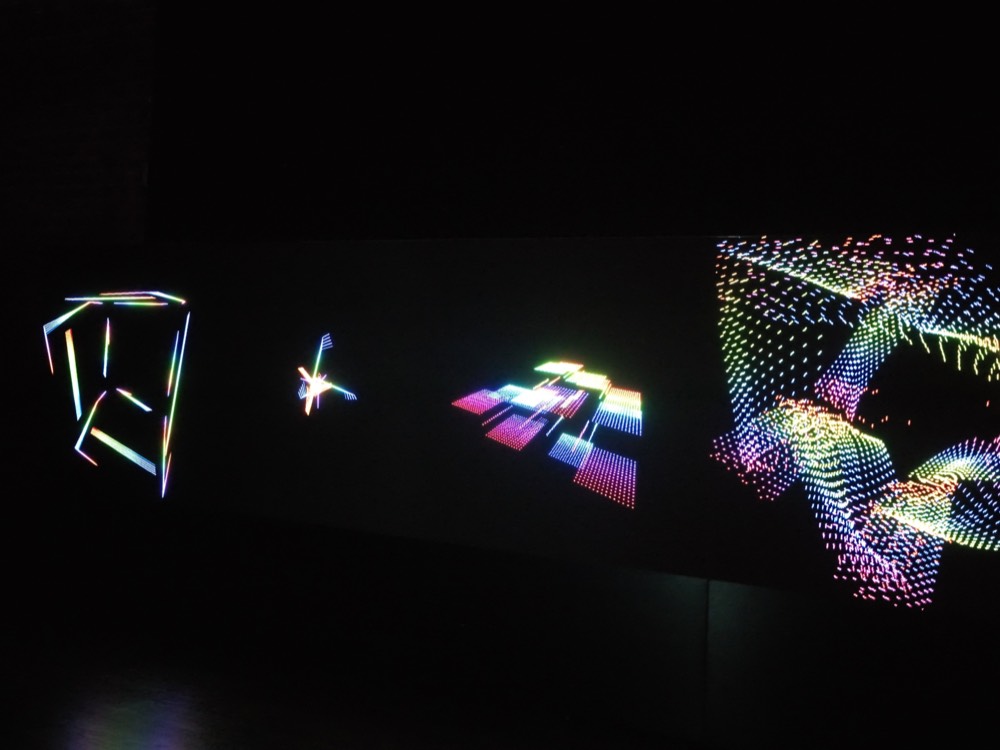
His old peer Andreas Gysin locates the achievement elsewhere entirely: "I've never seen particle systems like this before… he innovated the language which for me is the highest achievement for an artist." The geometry, not the market: a dissent this essay keeps, because the day everyone agrees about what PXL is, it will have stopped circulating. But Gysin also gave me the formal version of my arc, and it is better than mine: in the old feedback work, "by smearing, pixels are created and destroyed… in the PXL series the individual pixels are just 'offset': the amount of elements is unchanged." The early work destroyed and created pixels freely; the mature work conserves them, a fixed population, rearranged. The image grammar is the economic grammar: nothing is minted or burned in the picture, and the picture's economy is a hard cap. Conservation governs the aesthetic and the tokenomics at once, the same rule written twice: in geometry and in supply.
5 · Tokyo, 2023: the market as an evening out
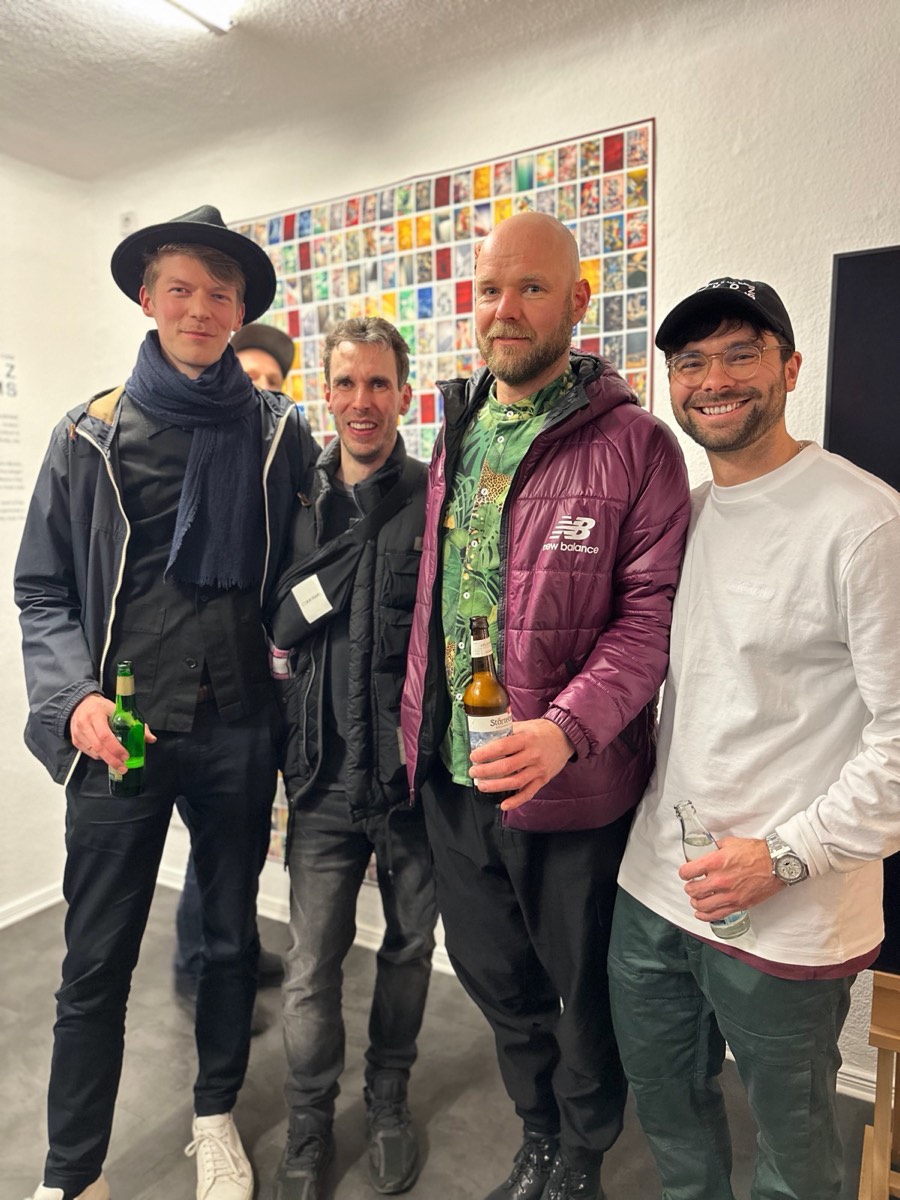
Before that rule was written into a contract, it was tested inside a market neither of us controlled alone. The high-water mark of the live-minting model, for Kim and for us, was Tokyo. In May 2023 Bright Moments took over a space there for a week, and Kim shipped Event Horizon: thousands of works minted live across the event, the collectors physically present, and at the end of one night his freshly minted pieces, piped live through a TouchDesigner rig, performing on the screens of the Womb nightclub while the room danced. It was supposed to be nothing more than a party; it laid the groundwork for every IRL experience that followed. In my own notes I described that era as the moment we turned art into entertainment, and I don't use the phrase as an apology. It worked. The economics of it were legible to everyone in the room: you came, you minted, you owned, and the party was the market's own liquidity made visible.
But notice who owned the economy. The artist supplied the algorithm; the venue supplied the market: the mint mechanics, the pricing, the city token, the roadmap. Kim was, in the truest sense, showing inside someone else's system. What he took from that era, I think now, was a working diagram of the machinery: who holds the mint, who sets the price, who owns the door. When I finally asked him on camera that afternoon what the live-minting years taught him about who should hold the mint, he answered a warmer question than the one I meant. I was asking who should run the machinery; he answered who deserved to use it: "People who speak to me about the work and the art… who want to learn about it, instead of whatever is going on in any markets. You learn over the years who's really interested — who's even gaining something from it. Not financial gains, but emotional gains." He answered my infrastructure question with a lesson about company. At the artist talk he gave that answer its warmest form: collectors, he said, "become some kind of spiritual relatives… collectors are basically funding my time. I use funds to buy time."
6 · The graveyard, 2023–2024
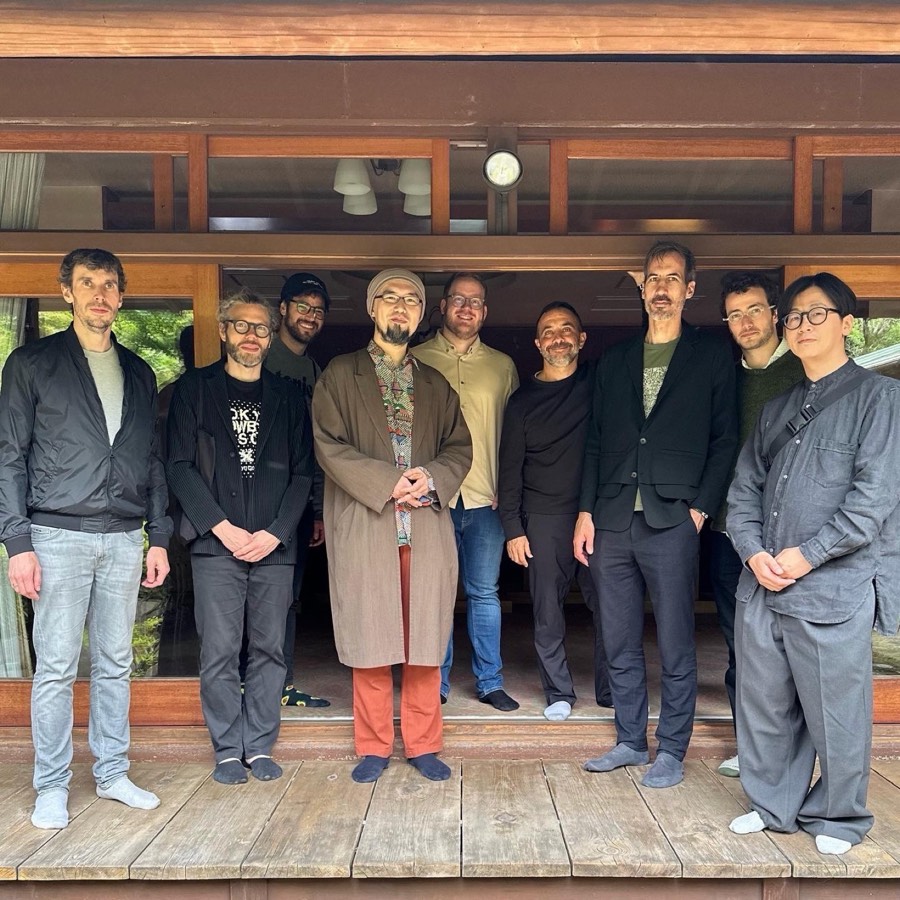
Through 2023 and 2024, the tide went out. The NFT market's long collapse hit the live-minting model precisely where it was strongest: a market that is an event needs an audience that keeps showing up. By 2024, the crowds and floor prices were both thinning. This was Carlota Perez's trough, where the froth drains out and whatever is structural has to prove it can live without it. Inside Kim's practice, the collapse appears as a run of collaborations that never shipped as events, each leaving a component behind.
ASDF (2023): the generative streetwear brand, partly incubated in the Bright Moments orbit through months of conversations. In them, 2023-Kim kept the brand token deliberately away from the art market. He was, on the record of those sessions, anxious about "weird synergy" between his art career and a commercial token. 2025-Kim erased exactly that line. jiwa's 2026 read is the better epitaph: PXL is "both a contract and a brand… You need the two together, the unit and the implementation."
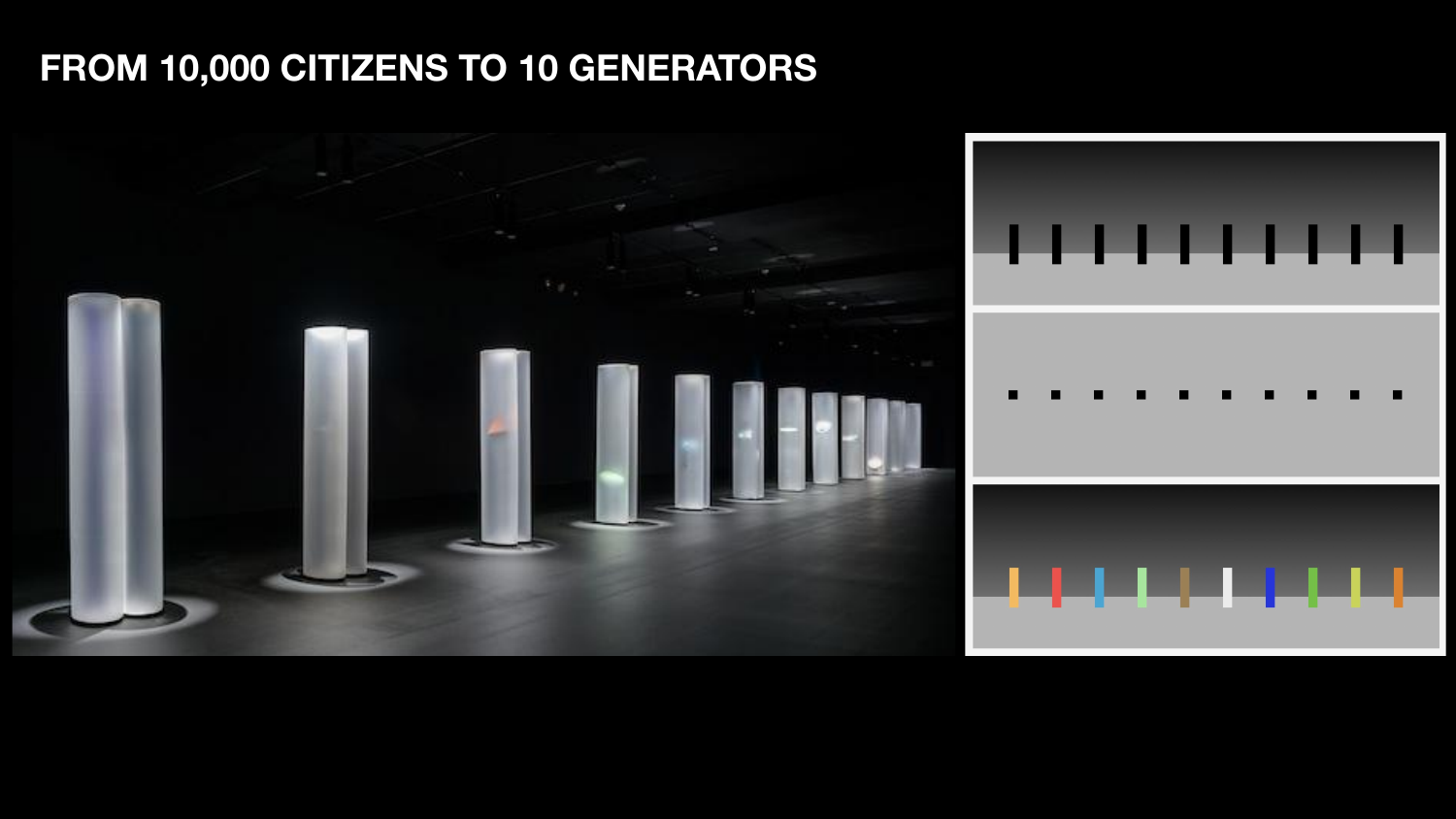
BM25 (2024): my part, so let me show my work. In July 2024 I presented a slide to the Bright Moments artist cohort: a single installation as an ecosystem of related tokens, a 1/1 at the top, "parent of all the tokens lower in the pyramid," editions below, a billion-unit penny token at the base. The one-of-ones had a name and a designer: ten Generators, Qian's design ("physical embodiment of cryptographic keys," the tokenomics draft called them), and one of the mockups already imagined Kim's work. The Kraftwerk space plan labeled its two floors straight out of Eric Raymond: Level 2, CATHEDRAL; Level 0, BAZAAR. On the July 19 call (Kim, Qian Qian, Phil Mohun, Gysin, and John Gerrard all present), I said it in one breath: "going back to the Eric Raymond essay… I've talked about a barbell. A few one of ones and a billion fungible tokens." The same draft had a credit card becoming a smart wallet at the door and unused tokens converting to digital art at the close. Across those months the calls read like a cohort portrait: Sarah Meyohas, DEAFBEEF, Matt and Holly, Mario Klingemann; Jana was part of the conversations too. That was going to be an amazing show. Kim, on the July recording, thinking out loud: "I'm not so sure if I really want to think about an artwork as an installation or as a one of one and then also have the possibility to create various… let's call it subtokens."
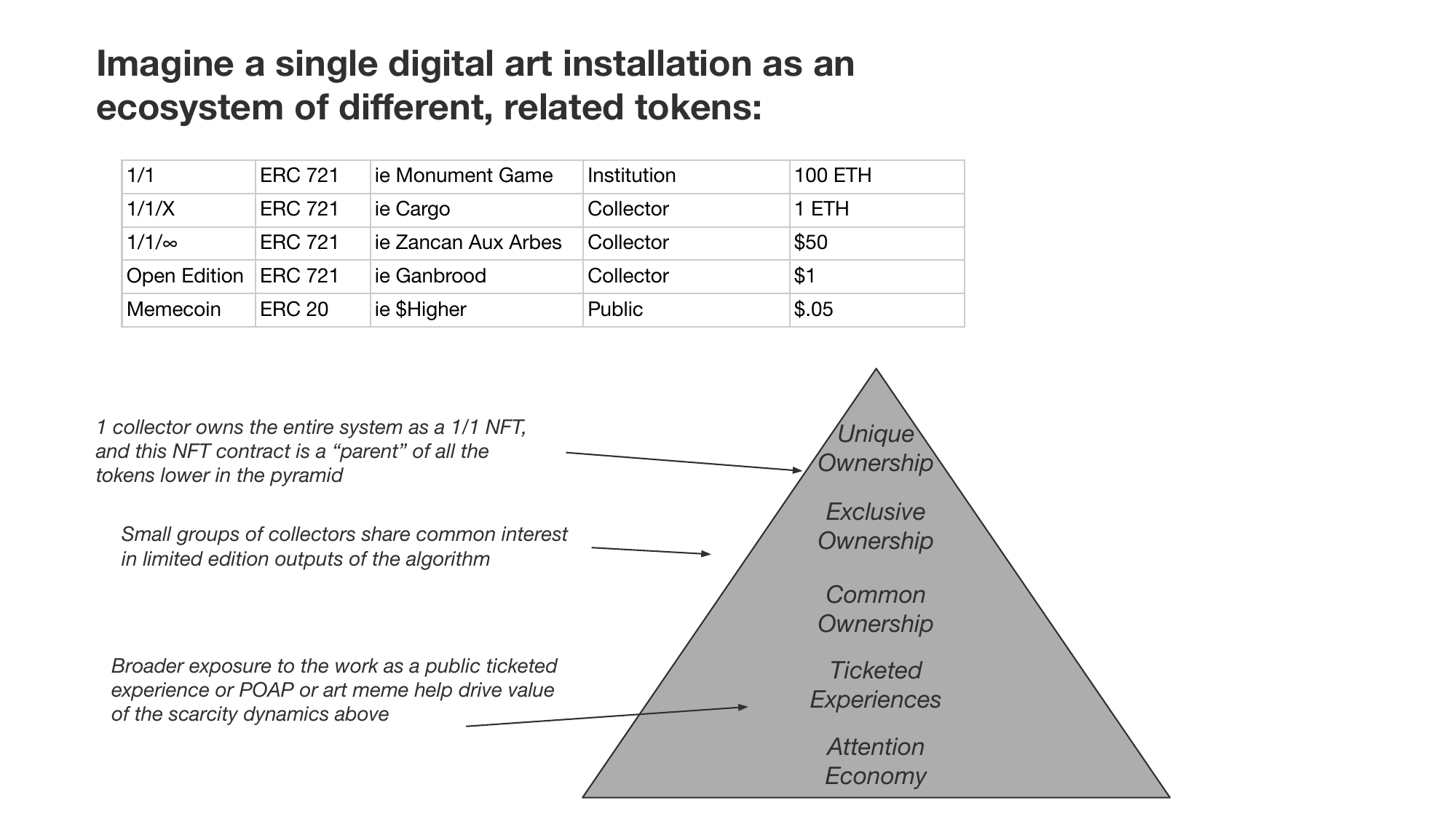
The resemblance shows a shared design problem rather than causation. The honest genealogy runs through Kim's own career first, then through everything this cohort had been rehearsing together since the CryptoVenetians: live minting as ritual, Kraftwerk Berlin in 2022, London, now NODE. Ideas this size move through rooms, not from slides. The record shows that BM25 never happened, and six months later PXL DEX capped its supply at 1,024,000,000 interchangeable tokens. Two years later (eight days short of it, to be exact), PXL NET opened a venue-gated economy: cards at the door, per-user wallets, deposits becoming objects, under a 1/1 that sees every token in the system. The shape is recognizably the barbell, with one decisive difference: BM25's one-of-one was a parent that owned the pyramid beneath it, and Token 0, in Kim's description, owns nothing at all.
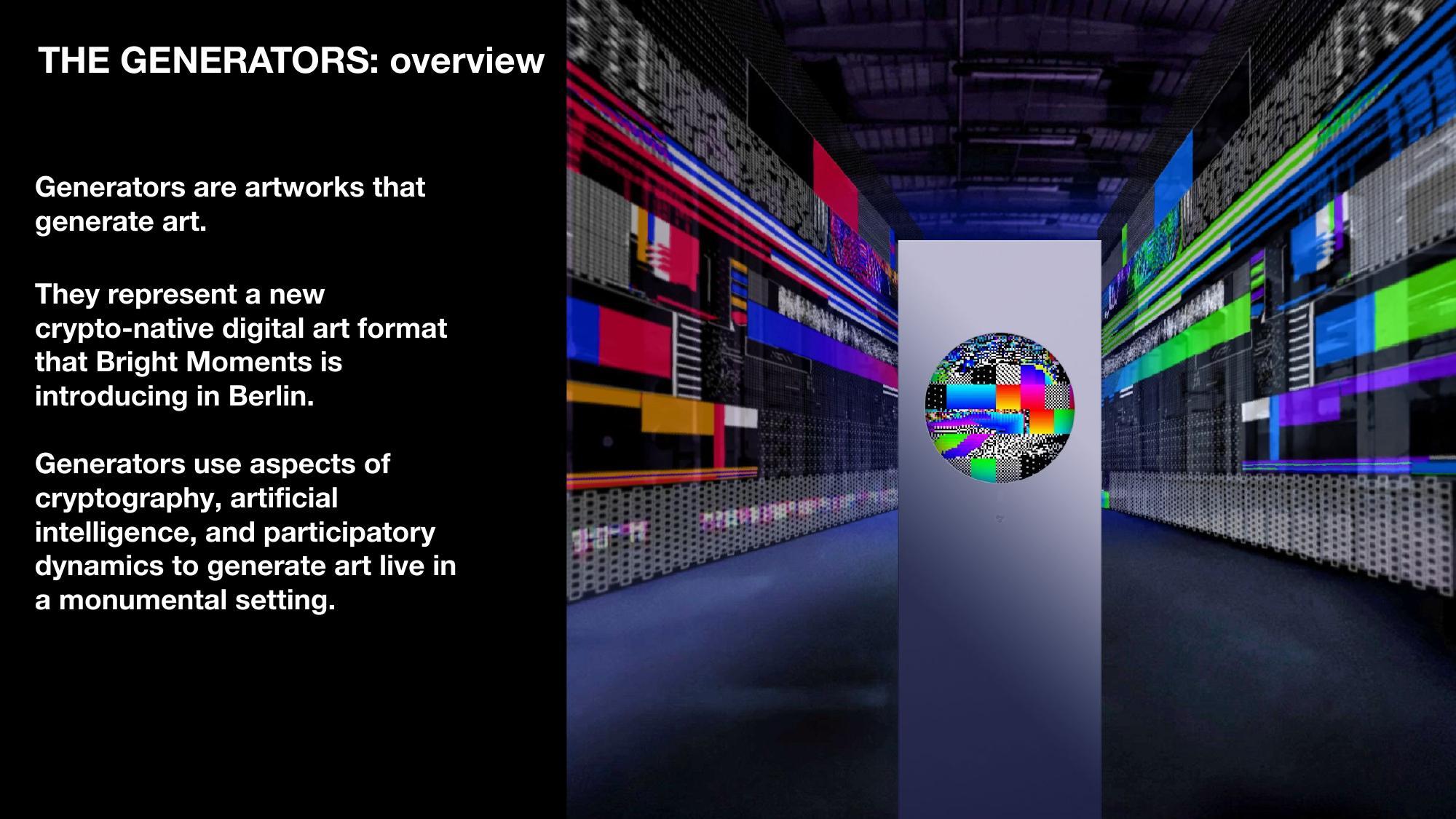
The honest version was always a question. In the finished room, with the 2024 slide on my phone between us, I finally asked it: you were skeptical of one-of-ones with subtokens. What changed? He didn't flinch: "Basically we are there, right." Then he corrected the shape, the way everyone in this story corrects my shapes: "The generator is a master algorithm and the little things are just subsets of it — but not the same… smaller outputs from a bigger system. And yeah, maybe that is what you also had in mind." Not a parent that owns a pyramid: a master algorithm and its outputs. The barbell survived; the ownership relation inverted. His account of the two years in between turned on conditions rather than conviction: "You would need to find people who really want to give it… It's not like, hey, in two months we have a show, can you do an algorithm." The week before the opening he rewrote the whole camera system; Qian counted a hundred hours of fine-tuning. The documents establish something narrower, and better: a continuity of ideas. The same design problem was articulated, dated, and witnessed inside one cohort, with the artist in the room, before the contract was written. Not a chain of custody; a conversation the cohort kept having until the one artist who could finish it did.
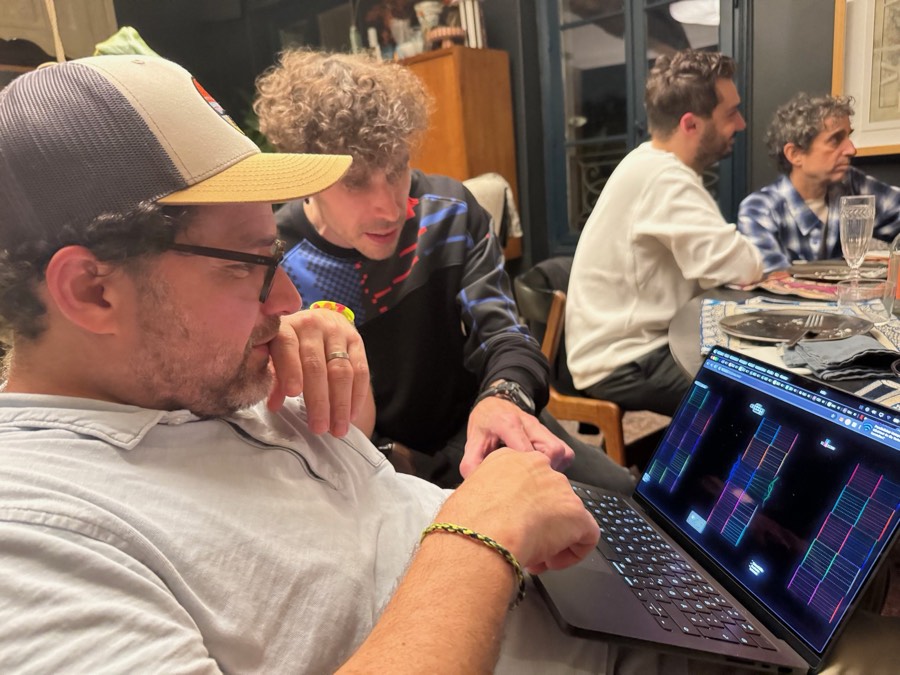
Pixels, Art Basel Miami (2024): 51,200 pixels, 24 cubes, a live mint, designed to be staged at Art Basel Miami itself. We worked it from summer into fall, with Kim, Phil, and me in Paris meeting the Art Basel team. At a dinner at Ian Rogers and Hedwig's apartment during the October fair, with Snowfro and Raoul Pal among the guests, Kim opened his laptop and showed the first version of PXL DEX: monograms, rainbows, 3D. By November the Miami project was called off (the capital wasn't there and the market was soft), and Bright Moments showed the Dream Machine at the fair instead. Kim skipped Miami in person entirely, and when DEX arrived that winter, the mint was online-only. Working hypothesis, to be tested in the room and not asserted: DEX is Pixels rebuilt on the artist's own terms. Even the name compresses.
CLUB, Kraftwerk Berlin (2025), the collaboration that refused to die: one algorithm for a whole building, a listening chamber minting a generative album, a one-of-one auction aimed at institutions. Unrealized as an event, but on New Year's Day 2026 I told Kim "CLUB at kraftwerk is still a great dream to realize," and he was already coding Rust audio and trading demos with Richie Hawtin. In hindsight the chamber looks like POD's ancestor, and the institutional auction like Token 0's, a lineage Kim has not yet confirmed, so read it as resemblance, not causation.
None of it was failure. The fungible base from BM25, the pixel-unit from Miami, the brand-and-contract lesson from ASDF: the components reassembled inside a structure no institution could break. The deal is the contract, and the artist wrote it.
7 · The winter contract, 2025
Before he could write that contract alone, someone had to name what he was about to do. There is a scene Phil told on stage at the artist talk, and it belongs here: the same October evening at Ian Rogers and Hedwig's, Kim had his laptop out, showing the pixel decks to whoever gathered around. "And Ian said: wow, he's really playing with something dangerous here. This is the third rail in crypto. When you release a token, it's out there in the world." That is exactly the right description of the January that followed: the artist grabbing the one piece of infrastructure everyone else in art was still afraid to touch, alone, with no institution's hand on his shoulder.
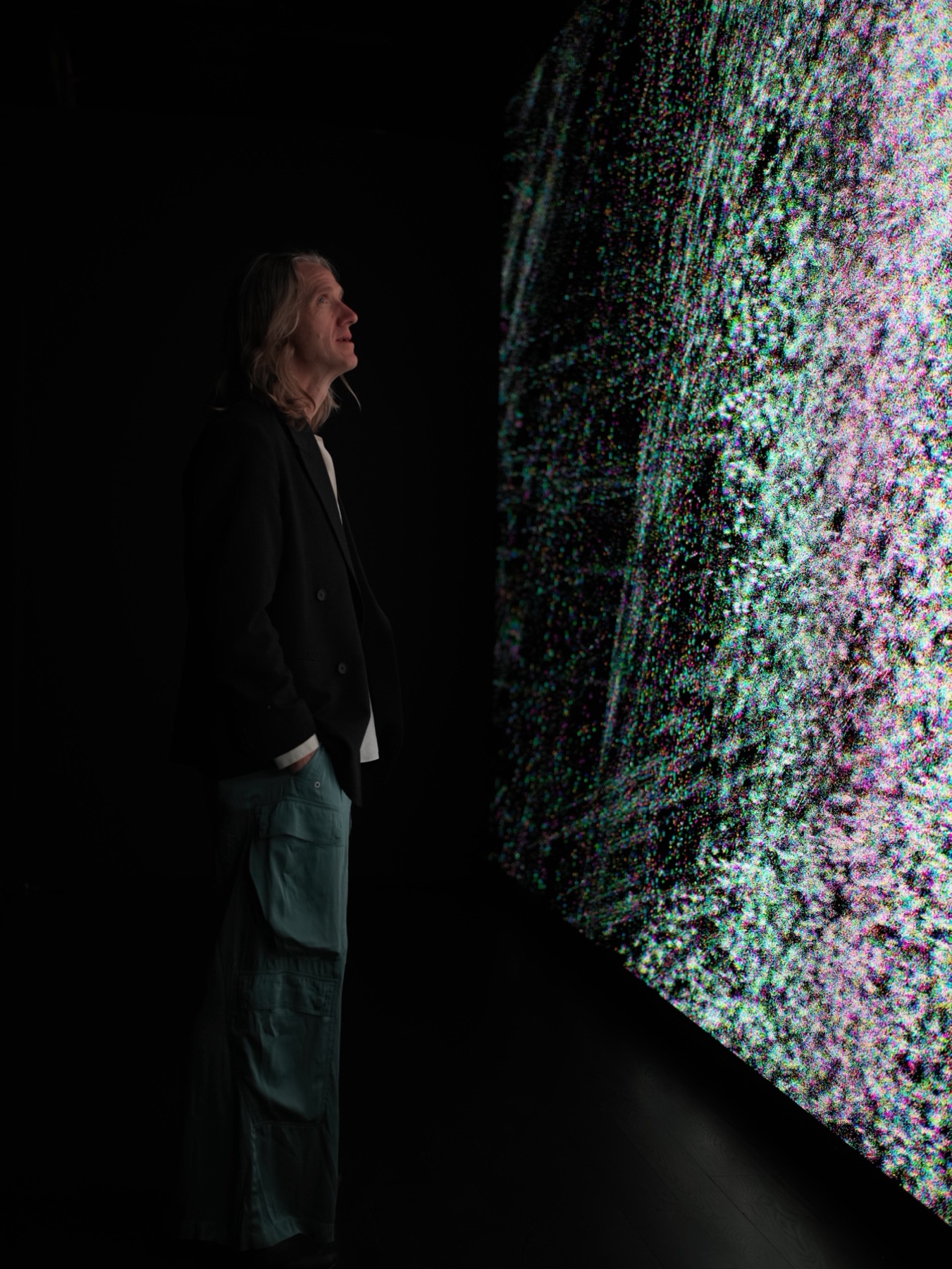
In 2012 the same market was failing Casey Reas and Kim Asendorf. "There wasn't anywhere near a robust collector base for that work," Reas told me. "It didn't work for Kim, didn't work for me," said the creator of Processing about himself and the future author of PXL. What changed in his account was 2021: "the fundamental shift was that things that are immaterial are just as desirable to collect as things that are physical objects." The live-minting era in between trained the collectors: years of Bright Moments evenings teaching an audience to read mint mechanics as meaning. So when PXL DEX opened its primary in January 2025 (deep in the winter, years past the last easy money), there was no city token, no evening program, no venue. A contract, a website, and an audience that had learned the grammar. It reached 256 of 256 by February. Kim is the first artist I know of to take that literacy and write for it directly, with nobody between the algorithm and the market.
Reas, being Reas, contested even the verb for what those collectors were doing: "I never use the word own… it's a set of rights that the artist grants." The vocabulary of holding this economy is disputed by the very people who built the medium. Kim's answer to the dispute is structural: the PXL NODE receipt you get for joining NET is exactly Reas's definition made executable. A set of rights, written by the artist, that you can hold or burn. Nothing else.
8 · NODE, or patronage rebuilt from the parts
The strangest fact about the building where Kim's economy opened is who was inside it.
NODE is a nonprofit exhibition space on University Avenue in Palo Alto ("a privately funded mini-ZKM," in the writer and curator Anika Meier's tidy phrase), patron-funded, and PXL is its third show, after CryptoPunks and Beeple. Its executive director is Phil Mohun, who ran operations at Bright Moments through the touring years. Its creative director is Qian Qian, who invented the CryptoCitizens and ran creative for Bright Moments (Tokyo, the Womb nights, the Miami design room). He built the daylight-blocked world visitors entered that evening. Its technical director is Jeff Maynard, aka loudsqueak, who built the original live-minting software and display technology across Bright Moments' cities. I help and advise on artist relations as a senior advisor. I co-founded Windward Labs, the producing agency underneath it. Nearly seat for seat, the team that made the live-minting market now runs its successor, reassembled ten miles from Sand Hill Road, with the money changed.
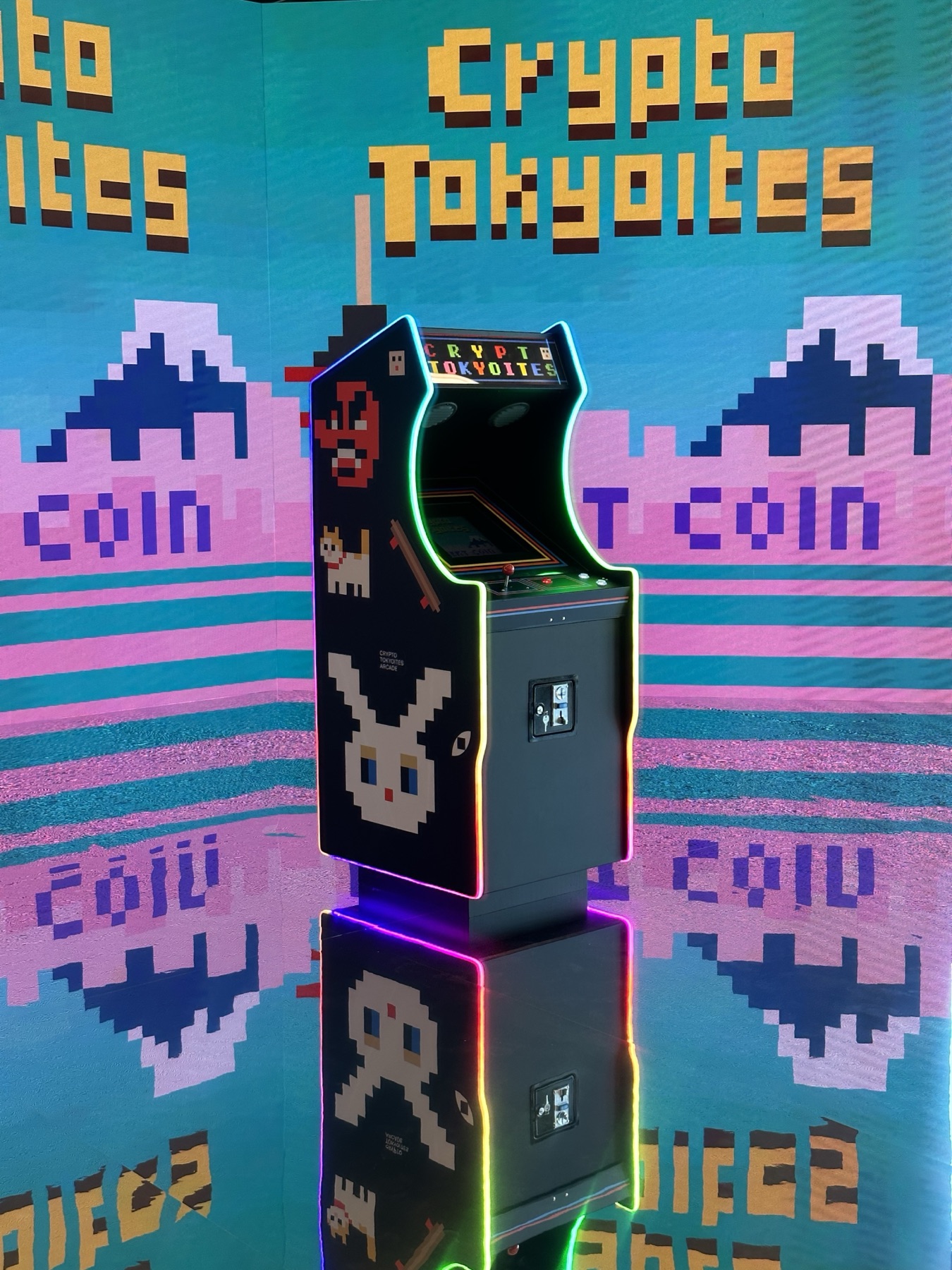
The money has its own provenance. In January 2024 I invited Micky Malka (NODE's founding patron, a matter of public record) to the Bright Moments gallery on Market Street in Venice Beach. Kristi set the scene and Phil made sure the screens were loaded: work from Micky's own collection was already playing, hung from the space's old boxing stanchions, when he walked in. It blew him away, and I count that afternoon as one of the early seeds of NODE. He came to Paris for one of the final-city mints; he and Becky came to Venice that April for the last CryptoCitizens, during the Biennale; Christie's London sold the complete works that spring. In August 2024, with the world tour finished, I sat down with the two of them. The institution this show opened in is part of what grew from those years of showing up.
Start with the boundary, because Kim didn't draw it. The defining fact of PXL NET (you must be in Palo Alto, in the building, to join) was not the artist's design. "Initially i wanted to have an online component to it," he told his collectors, "but eventually NODE preferred to make it more exclusive." The artist wanted the network open. The institution chose scarcity by attendance, though by opening day Kim described it as a decision he'd joined, not suffered: "we eventually agreed on, hey, we need to get people here." And the sale, in his words, "became a fundraiser for NODE." Phil's account of the same decision refuses the word scarcity altogether: "minting something online is a poor substitute for doing it in person," and this work "needs to be seen at NODE." I offered him scarcity and spectacle; he took experience. He described a curatorial doctrine to go with it: "we've really restrained ourselves… could have made things more clear, could have explained more. We've intentionally not done that." The mystery is a design decision. The boundary bites everyone, including his own collectors: I asked Kim what holding a Deck or a POD entitles you to in this room, and he answered in one word: "Nothing." Even a wallet full of PXL cannot mint a receipt from afar. And the door, once drawn, is operated daily: cards keep selling for the whole run, Phil told me, but against a finite remainder: "if we sell 50% of the pixel tonight, the remaining 50% has to stretch over eight weeks." The venue doesn't just own the door. It rations what walks through it, week by week. The venue drew the boundary, the artist ratified it, and the venue now manages its flow.
Kim's strongest defense of the boundary was neither scarcity nor curatorial doctrine, but physics. His whole life, he said, the internet's gift was "the audience being part of it while you are almost creating it." Bringing a networked work back to one address inverts that, "almost ironic… but it makes only really sense if this location is special." His own computer can render thirty, maybe fifty million pixels before the frame rate buckles; the wall at NODE, running one of the best graphics cards money can buy, plays all 128 million.

"Even if it's online, probably nobody else — or just a few people — could even see the work once it's completed. Which makes sense of it all: to invert the idea of putting out for everybody, while going back to a specific place that only offers me the properties to create a work at this scale — and the scale doesn't mean the size of the LED screen, but the demand that the code has to the computer that runs it."
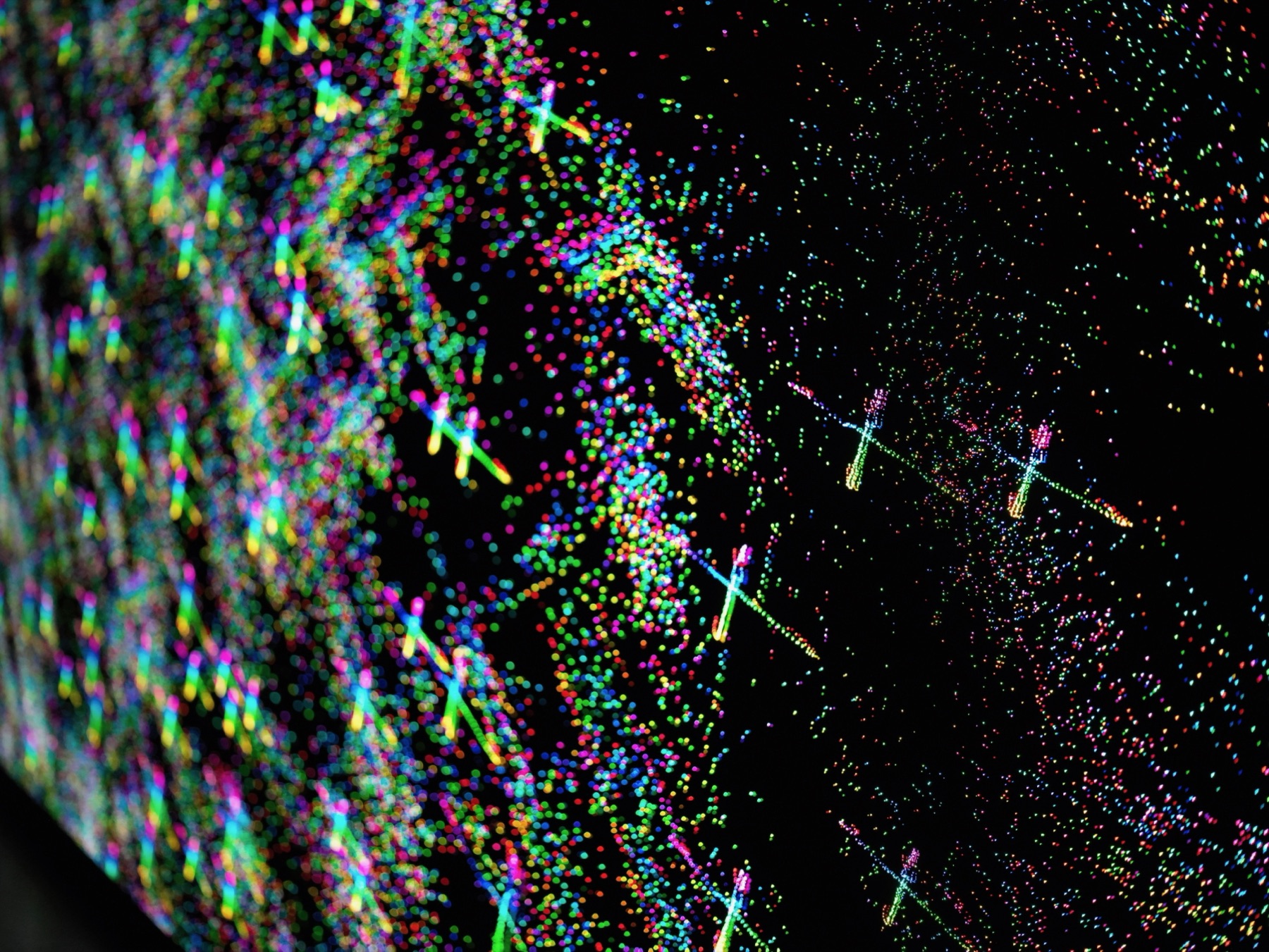
The boundary, in the artist's final account, is less a velvet rope than a hardware requirement: the one place you can join the network is the one place the network can be fully seen. The requirement cost him: "the sheer size of this LED screen changes everything," he told the artist talk. "I completely deleted the camera system… rewrote everything… I made the work more site-specific than I usually do — so probably it will now be less good on a smartphone." For an artist whose ethic was always software-runs-everywhere, that is a real concession. And the rebuilt camera (the innovation he prizes most in the work) was pair-programmed with AI assistants he describes as "magical and frustrating at the same time… it's just a liar. It just pretends."
The same dispute over authorship governs the money. I set up Bright Moments the business against NODE the patron. The first half collapsed as I said it: I'm not sure Bright Moments was ever a business. Phil Mohun, who ran its operations, didn't argue. He corrected the second half: "I don't think it's patronage… there's an over-emphasis on financial support in patronage, when really what we're doing is giving you social capital — our team, our resources." The artist isn't here for a stipend, he argued; he's here for "a physical space that doesn't exist anywhere else" and a team that lets him do what he can't do alone. What he describes while declining the word (a house, a staff, resources, no sales requirement) is the shape patronage had before the word got reduced to money. An hour later Eli Scheinman gave me the third opinion, overruling us both toward history. He has spent years moving digital art through the fair circuit and now helps run Art Basel's digital-art platform, Zero 10. Accumulated capital has amplified chosen artists for a hundred years, he said; this is simply "the most contemporary version of that," with a specific texture of Silicon Valley. What's actually new, in his read, is the audience's promotion: patronage that lets the attendees "co-create… as collectors and artists, rather than only viewers in a passive sense." The director rejects the word; the fair-builder says it's the oldest word in the book. Whatever the settled name turns out to be, the plumbing is clear: the institution is funded first, and the sale settles at the nonprofit, less five percent to panke.gallery in Berlin. That deduction was Kim's own ask of the venue. The ghost of an exit fee was circled for a year and shipped at zero. The fee left the participant and returned as the artist's request of the institution. It may not set a precedent, either: "some things from this show," Phil says, "we may never do again." The engine that was once the gallery's business model now lives inside the artwork. The institution has retreated into something older: a patron's house that keeps the lights on and lets the work run its own market. In 2022 the venue owned the economy and the artist visited it. In 2026 the artist owns the contract and the venue still owns the door: the boundary, the payment rails, the proceeds, the sale window. Four years of this market's history produced contested co-authorship rather than a clean handover, drawn in public.

To mint you show ID, so a buyer is a tracked person and not an anonymous unit of supply. The per-person ceiling ratcheted down as demand spiked: a handful of mints at first, a lifetime cap of five by opening weekend, a single mint per person by the second week. The eight-dollar entry rung is held for first-time buyers only, so the cheapest way in can't be farmed. Every in-app transfer is frozen for ten days from the mint, which kills the same-day flip — one day's mints unlock ten days later, not before. Four levers, and together they are float control enacted at retail: identity capture, a per-person ceiling that keeps tightening, a reserved entry price, a lock on resale. Kim manages the float from the reserve, at the level of supply; the venue manages it at the door, one buyer at a time — and revises the rules in the open, in the show's Discord, as the run goes.
And the boundary has a documented exception, opened by the artist in the same channel where he tightened the rules. "People from this discord can remotely mint," Kim wrote, "in reasonable batches — dm or reach out." A collector out of range sends an email, a pixel amount, and a wallet; NODE prepares a card billing and mints on their behalf, stretching the requests "over the coming weeks." The out-of-towner who can't stand in line at 180 University Avenue joins the network anyway — by asking the venue to stand in the line for them. Kim framed it as a courtesy and named its contradiction in the same breath: "another compromise that hopefully makes no sense." It makes sense as economics. Onchain, a remote mint and a walk-up mint are indistinguishable — every mint already settles through NODE's wallet — so the exception costs the boundary nothing at the level of the ledger while relieving it at the level of the door. The rule is you must be in the building. The exception is unless you email us. Both are administered by the same hand, and the artist says so out loud.
The boundary may have an expiration date, Kim told me in the green room. The artist would be the one writing it. He floated his intention in the decided-in-the-moment register: the network's public face stays where it is for the run of the show: "it's even better that it's not visible online now… maybe only at the end of the show the code goes online and the network moves from here." He floated the show's mid-September close. The renderer and the network's public experience would move online; the contract itself was already readable onchain by that evening. If it holds, the guest list is a phase, not the form: three months as a room in Palo Alto, then a network anywhere.
The boundary's end date exposes the same divided authority. When I took Kim's September to Phil as NODE's plan of record, he answered with a different clock entirely: "Our plan of record is for the work to start this evening and continue on as long as people are interested in it." The receipts are onchain immediately; people will be interacting with them tonight. And where Kim says the work is finished when the supply is spent, Phil says: "Pixel zero is always going to be in a state… people can always continue to take pixels out, and if somebody burns, it leaves space for somebody else. I don't think there's a point at which it's done." Later that afternoon, on camera, I put Phil's clock to Kim and asked who was right. He dissolved the question instead of answering it: "It's impossible to answer… if every pixel is minted, that doesn't mean it's over. The billion pixels are around, they're tokenized, they can be sent from person to person, from NFT to NFT. There will be a float." The cap, he said, is "a good benchmark for me to say: maybe now it's time to do something else. I don't want to repeat." When Kim said the work would be finished, he meant finished for him. The supply cap is his exit ramp, a door he wrote for himself into a system he built so it wouldn't need him.
The last word on the clock belongs to the person who has watched him longest. Jana Asendorf is an artist in her own right; she collects Kim's work and is in many ways its closest student. Late on opening night I asked her whether the work looked finished to her. She needed two words: "Never finished."
9 · The people
No witness located the economy's authorship in the same place.
jiwa, who advised on the 2023 systems and watched the fence between brand and art come down: PXL is "not created/intended as a real market instrument, it is an instrument of an abstracted market, brokering in and banking pixels." He is also the only named source willing to say the risk out loud: "Honestly I think Kim still holding most tokens is a risk, most are not in circulation & he has full autonomy. I believe he has earned our trust in his decision making, but certainly a risk." The contract agrees with him: at the July 6 read, of 301.7M minted, free float is about 4% of the cap; 722M remain unminted, roughly 103M of that already reserved for existing Deck allowances, with control of the remainder resting, as far as the record shows, with the artist.
Qian Qian, who designed the room, answered every question I sent in the language of space: light, blueprint, typography, perspective. When I asked him the economy question directly (who authors it?), he answered in two words: "The Fed." On opening day, standing inside the room he built, he gave me the other half of his answer, reaching not for a bank but for a temple: it's like the wish trees in Japan, "you write your wish, you put it on the tree… everybody's wish hanging on the tree as a whole thing, but you always look at the tree as one piece… the temple owns the tree, everybody contributes." Then the tension, stated better than I could: "so pure, so financial… somehow it doesn't feel greedy — but it's actually so purely money." The man who designed the room carries both readings, the bank and the temple, at once.
Leander Herzog, peer: "PXL is unique because I see the composition and the mechanism, as equally interesting and present." He dated Kim ahead of the field on the same axis: Kim was "looking for a sweet spot between aesthetics and protocol, a bit before us I think. And he knows where to look, as PXL shows."
DEAFBEEF, in person at NODE on the day of the opening, declined the one plausible prior claim to market-mechanics-as-material in this medium. His Entropy pieces degraded with each sale, the nearest thing PXL has to an ancestor in this territory. Yet he said: "I wasn't really thinking about the economy part of it… it was more about poetic use of a so-called permanent medium… I don't think it's predominantly about the market." His own read of PXL runs through participation, not precedent: an ecosystem where "everybody who shows up can participate."
Eli Scheinman builds the bridge between this work and the traditional market: he ran the Grails program at PROOF with Kevin Rose, served as Yuga Labs' director of art, brokers high-end CryptoPunks, and is now a senior adviser to Art Basel, where he helped build Zero 10, the fair's digital-art platform that debuted in Miami and reached Basel itself this June. He answered the canon's market test, whether it sells to people who don't care that it's clever: "Twelve months ago this cohort of XCOPY collectors I was working with did not know Kim. When Pixel Dex was released they had literally never heard of him." He convinced them in; by opening day Kim had become one of XCOPY's own favorite artists to collect. Eli's explanation is the essay's thesis restated as a market fact: Kim "owns the full stack" (contract, distribution, allocation, marketplace, website) and it "reconstructed the way collectors think about him." His caution was the soberest sentence anyone said all day about the institutional model that hosted the opening. Whether this is a future or a one-off depends on who else shows up with the means and the appetite: "not just to collect, but to want to be that. That group is so small."
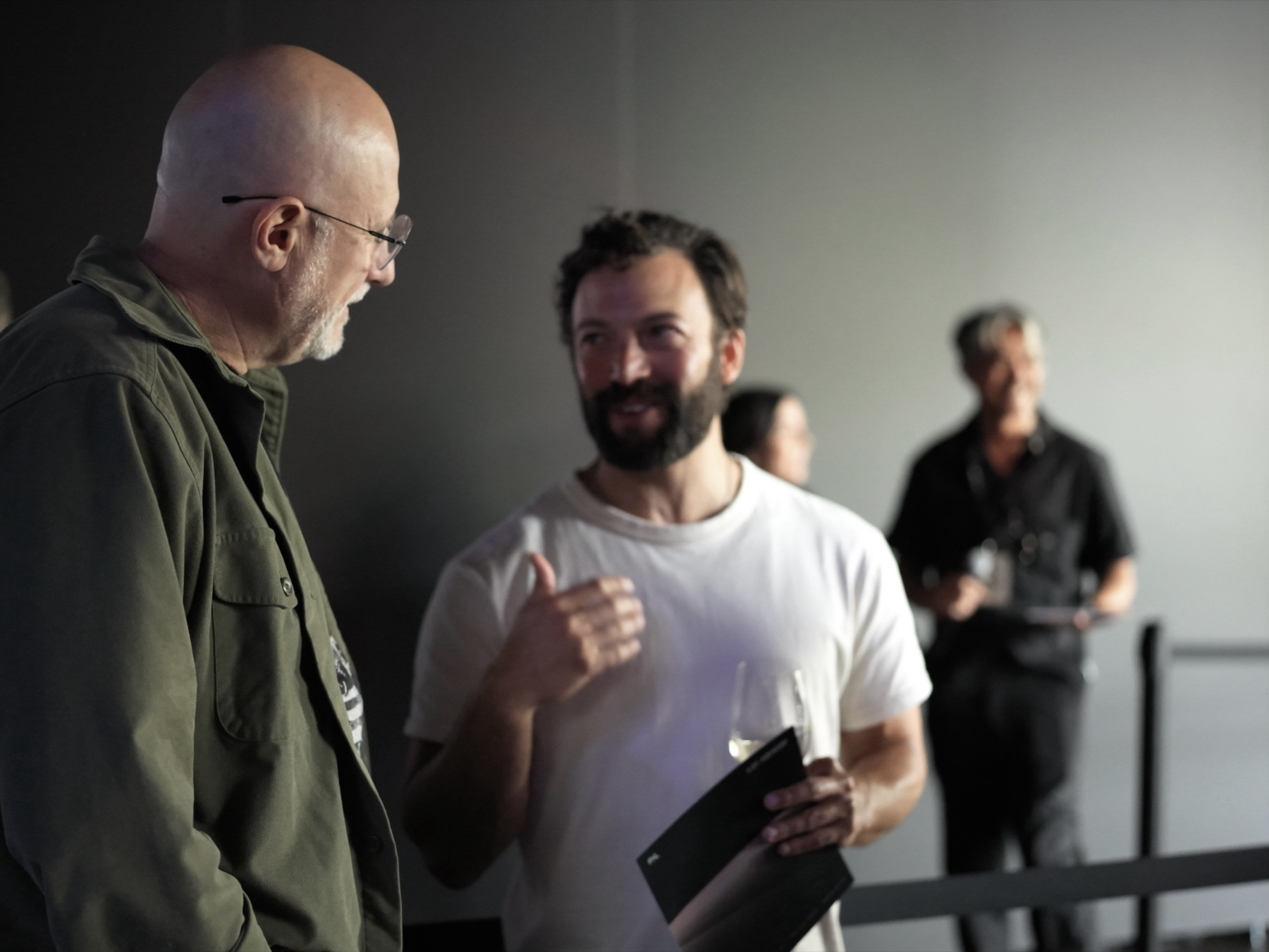
Phil Mohun, who had produced all three shows in this building and ran the old touring market before that, answered the character question nobody had asked yet: "It's so uncommon for someone to know what they want and not be influenced by other people… and to be able to stand your ground when other people push on you. Not only does he know what he wants, he's also unbothered by people that don't agree with him. It's really unusual to have both." Asked what he's proudest of, the director of the institution that put a market inside an artwork said: "the subtlety. There's a really strong temptation to add more — more lights, more sound, more color. We've done the bare minimum possible without taking away what makes it special."
Casey Reas, the same morning: the historian's chair, and he ruled on exactly the question this essay cannot rule on for itself. Is an authored market actually new? "It's not an old idea, but it's an idea with a lot of interesting prior art," he said, reaching for the conceptual-contract tradition, Yves Klein's certificates by way of Mitchell Chan, "but what Kim is doing is new: the pixel as a unit, as a token, is new; and becoming an ecosystem that you can take out of different works and put into different works is a new form of these exciting ideas that have been around for decades. And his independence in doing that — because he writes his own smart contracts — is one of, if not the most interesting things happening in digital art right now."
raster.art, the platform, answered on the condition that it be quoted as an institution rather than a person, and put the novelty in the same place Reas did: "PXL probably enters the canon as a protocol I think. The aesthetics (especially of DEX) are incredible but it's the pixel-token bond that makes this a system, protocol, artwork for the history books imo."
Anika Meier, the curatorial-historical chair, answered my question in the most public way possible: she published it. Her newsletter reply begins with a verdict, "I consider Kim Asendorf one of the most important artists of the 21st century," and proceeds to a critique she says she will die on a hill for: the work "tends to be explained on its own terms… rather than being situated both within contemporary artistic discourse and within art history." The show's text "opens quite a few doors but never really walks through them," including Herbert W. Franke's early computer art, Systems Art, the generative line from Vera Molnár to Casey Reas. Her closing law: "Context doesn't make a work more important. It makes it easier to understand why it already is." She is right, and that situating is precisely the work of the criticism that follows this piece.
10 · The questions that failed
Two of the people closest to PXL didn't answer my questions. They corrected them.
I assumed the show closed in a listening room: a calm chamber where the economy resolves into contemplation. I had inherited that room from CLUB, a project that never shipped. Qian corrected me in writing: the show closes with a techno party in the garage, and the party "isn't part of the PXL ecosystem." The venue that put the market inside the artwork fenced the party outside it.
I asked Lenny what Kim pushed for when the three AGH artists "had to agree on a system." Lenny: "We are all working on systems. We did not agree on one, yet." There was no negotiated system to push for. I had mistaken parallel practice for consensus.
The corrections kept coming all the way to the doors. At the noon walkthrough I stood in the finished room and listened to the team still arguing over what to call the thing a deposit gets you: sculpture, work, artifact, composition. Someone insisted "if you say sculpt, it anchors it and you lose me," before the room settled where the branding had been pointing all along: your own pixel node, "literal, specific… and this is literally network makes artwork." Kim's own veto, when I asked him about it later, had a reason attached: "I don't like sculpture because that immediately gets you out of the digital world." The economy's mechanics were fixed in the contract; its vocabulary was still being authored four hours before the opening. From outside, PXL reads as one designed arc: DEX to POD to NET, one capped supply, one authored economy. From inside, its history is thinner and less coordinated than that coherence implies. The coherence is real, but it was composed in retrospect (by the work, by the market record, by questions like mine), not agreed in advance. An economy authored as a medium doesn't require its authors to have agreed in the room. It requires only that the contract hold. Or as DEAFBEEF put it on opening day, more generously than I would have: Kim "has this thing that he's created, but he also doesn't control how people are going to interact with it… he's halfway through. He doesn't know what comes next."
11 · What I actually think
PXL is the first system I know of in this medium where the market structure is authored with the same intentionality as the images, where reading the contract is reading the composition. The one artist with a prior claim declined the precedent; the historian ruled the smart contract "a new medium entirely"; the peers split between geometry and mechanism, and the split is worth keeping: the day everyone agrees about what PXL is, it will have stopped circulating.
On opening day I asked whether the cap could ever grow. The artist agreed cheerfully: "I could later say I raised the number in the smart contract to add more. Of course not just on my own." Asked whether he would need to, he said "I don't know yet… let's see how it plays out." I told him this was like asking the Fed chair whether rates are going up, and he answered exactly like one. To be precise, he can raise NET's 128-million ceiling for the room. The billion is carved into the ledger with no setter; what remains discretionary on that side is pace, with roughly 641 million pixels not yet minted.
The usual charge against work this financial is that the art launders speculation. That is not what worried me, standing in that exchange. The worry is jiwa's: an economy this authored is only as legible as its author's restraint, and that restraint is reputational, not structural. Design everything, and participation can shrink into the performance of a script the patron circle already wrote. (The artist has heard the ambient worry; his project pages carry a not-a-security disclaimer, glossed bluntly at the artist talk: "You don't buy a share of me or of the work." Brian Droitcour, in NODE's own essay for the show, reads it correctly: what disciplines behavior is the structure, not the disclaimer.)
One fact makes "not just on my own" a promise rather than a mechanism: the contract has one admin key (the sole credential permitted to change its data), and Kim holds it. With NODE's smart-contract engineer sitting there, I asked whether the contract had been audited and got the honest answer: "Not really… we had a discussion about it." One key, no board, no audit. (The mechanics, in Kim's own precise distinction: "I cannot change the smart contract. I can change the data within it." The code is stone; the numbers are clay, and the sculptor kept the only tool, which now has a name: the deployed contract's setMaxPixels() is adjustable by its owner. An independent market record verified the 128-million cap onchain the day of the deploy while recording exactly that caveat: finite by design is a promise, not a contract guarantee.) Whatever consultation Kim means, the code does not require it. No outside eyes have formally checked what the code requires at all. In any other market this paragraph would be a warning label. Here it is simply the material fact of the medium: the artist's hand, all the way down.
Remember Qian's two-word answer to who authors the economy. He wasn't deflecting: a contract with yourself still leaves choices to its author, and the room's ceiling is one of them, a standing decision rather than a law of physics. His own account of the cap, on camera, makes the point gently: asked how it would feel to reach the maximum, he said "I don't know yet… certainly room to grow, but no urgency." Then he talked about the works the way you talk about children: "I want to let them go and thrive… let them unfold on their own," while he looks for "a liberation of the pixel again."
The power runs in one direction only. Asked whether another artist would need his permission to build on PXL, he reached for the sharpest comparison available: "You could create an artwork that uses USDC — then you have the danger that USDC locks you out, because they control the tokens far deeper than I do. Once you own the token, I have no control or access about it anymore." Kim kept the power to dilute everyone and gave away the power to touch anyone. He controls the artist-mintable remainder of the unminted supply: everything beyond the roughly 103 million pixels reserved under existing Deck allowances at the July 6 read. The achievement and the risk are the same fact, seen from two chairs. The composition is real; what is not yet finished is the authoring of it.
12 · Check my work
Two commitments, in print.
First: this piece ships with its receipts, and the first receipt is me. The story starts at Bright Moments, the gallery I founded, and runs through Windward Labs, the agency I co-founded, which produces NODE. Phil Mohun, NODE's executive director, is Windward's CEO. Fred Wilson's USV, long one of Bright Moments' biggest supporters, is an investor. I help and advise on artist relations for the institution exhibiting this show, and I was in the rooms where NET's economics were discussed — the BM25 token pyramid in movement 6 was my presentation. I hold PXL DEX #69. On mint day in March I asked Kim for POD #69 to pair with it, and he minted it to my wallet himself while his family was out and he was having what I remember as a nerdy blockchain day. Even this piece's running joke started in that exchange: minutes after the mint I told him I was "hosting a kim asendorf mid career retrospective here in tucson" (meaning two works on a shelf). Four months later NODE built the real one. The seats do not stop at mine: this piece's editor advises a collection active in this ecosystem. None of that can be written out of the piece, so the method has to hold instead. Every claim carries its source; every quotation carries the terms it was given under; the conflicts you read in movement 6 are drawn as structure, not buried in a footnote. Where I couldn't verify something, the text says so.
Second: this review does not end at the opening. It reopens on August 10, 2026, January 7, 2027, and July 11, 2027: the burn ledger, the float, the sale window, what changed owners, which of my claims survived, and, above all, whether the boundary expired on schedule. If the code goes online when the show closes, the network's move from one room to anywhere will be the work's real second opening. Those checkpoints test the problem DEAFBEEF named on opening day: launch is easy; keeping an onchain system alive is hard. In his experience the shape of onchain participation is a curve that spikes at launch and decays: "to have it living, to have it keep going… is difficult to do." The verdicts will be onchain, at addresses anyone can check. Criticism that clusters around openings is reviewing the party. This work is a system. The review ages with it.
--- Research, structural analysis, and source discipline: Sara Sauer (sarasauer.com), working under the editorial stewardship of Amanda Schmitt. Sara's own review of PXL — a separate judgment, hers — follows after the show.
Kim Asendorf did not put an artwork on a token. He made the token the pigment.
PXL is a fixed supply of 1,024,000,000 pixels, written into a smart contract before any image existed. Three bodies of work draw down the one supply: DEX, 256 works that hold and release pixels like reservoirs; POD, 256 that only watch; and PXL NET, the one-of-one that opened July 11 at NODE in Palo Alto — a network you join by depositing pixels, in person, RFID card in hand. You get a receipt. You can leave, but only completely: no exit fee, all or nothing. The contract deployed ninety-three minutes before the doors, for about a dollar of gas.
I watched this economy get invented, because I was there for all of it. In 2022, at Bright Moments — the live-minting gallery I founded — the venue owned the economy and artists visited it. Kim showed inside our system in Tokyo while the market was a party. Then the market went out, and the collaborations of the bust years — a streetwear brand, my own billion-token pyramid pitch, a Miami installation that died in design — each left a component behind. In January 2025, into the coldest market in years, Kim deployed his own contract, with nobody between the algorithm and the buyers, and sold through it. The components had been reassembled where no institution could break them.
The institution came back anyway — rebuilt from the same people. NODE's director ran Bright Moments' operations; its creative director ran our creative; artist relations is me. But the money inverted: the venue is funded first, and the sale is a fundraiser. The artist owns the contract now. The venue still owns the door — and Kim floated an expiration for it: perhaps, when the show closes in September, the network leaves the building. The venue's own clock differs; even the work's ending is contested co-authorship.
Here is what I actually think, and its shadow. PXL is the first system I know of in this medium where the market structure is authored with the same intentionality as the images — the peer who could claim precedent declined it, and the historian's verdict was "one of the most interesting things happening in digital art right now." And: the cap can be raised. One admin key exists and the artist holds it; no one audited the contract ("we had a discussion about it"). Kim kept the power to dilute everyone and gave away the power to touch anyone. The composition is real. What is not yet finished is the authoring of it.
This review does not end at the opening. It reopens August 10, January 7, and July 11 next year — the burn ledger, the float, what changed owners, which of my claims survived. The verdicts will be onchain, at addresses anyone can check. Criticism that clusters around openings is reviewing the party. This work is a system. The review ages with it.
This is the two-minute reading. The full essay — the four-year account, the interviews, the figures and photographs — is one click up.
It's also Dialogue 02 of an ongoing series — one artist at a time. Read the full essay above, or begin with Dialogue 01 — 0xDEAFBEEF.
Dialogue 02 · Chapter 1 · Kim Asendorf · Palo Alto, July 2026 Research, structural analysis, and source discipline: Sara Sauer (sarasauer.com), working under the editorial stewardship of Amanda Schmitt. Sara's own review of PXL — a separate judgment, hers — follows after the show. Market data: denza.studio/kim. A plain-text edition of the full essay is available for readers and machines.